
Customers ask us this every week. The honest answer is not decided by the age of the aerial alone. We look at the reception readings, whether the aerial is suitable for the property, the physical condition of the aerial and mounting, the cable and distribution equipment, safe access and the cost of putting the whole system right.
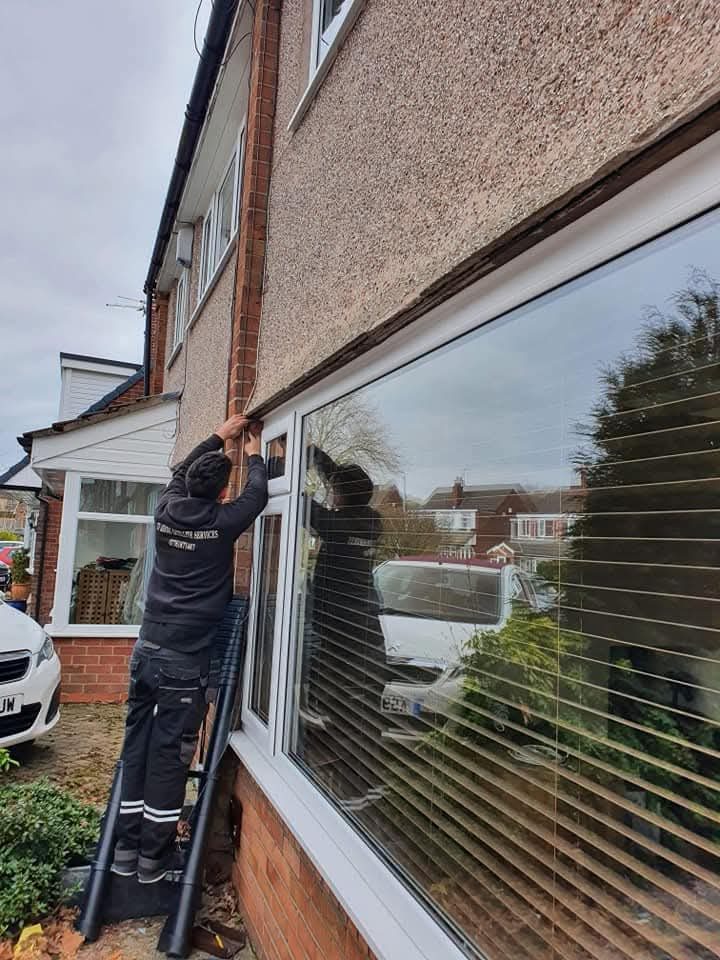
How we decide
- Measure reception. Signal strength matters, but signal quality and the expected services at the address matter too.
- Find the failed part. The fault may be a fly lead, wall plate, connector, splitter, amplifier, down-lead, aerial or mounting.
- Check suitability. An intact aerial can still be the wrong type, position or alignment for the reception available at that property.
- Inspect the structure. We check the aerial, dipole, rods, mast, bracket or lashing, fixings and exposed cable rather than judging one component in isolation.
- Compare the complete scope. A small component repair is different from replacing several deteriorated parts one by one.
Repair usually makes sense when…
- Testing shows the aerial is suitable and capable of delivering stable reception.
- The fault is isolated to a connector, cable, wall plate, splitter or amplifier.
- The aerial has moved out of alignment but remains physically sound.
- The mast, bracket or lashing and the remaining cable are serviceable.
- The repair is proportionate to the condition of the rest of the system.
In that situation, replacing a proven faulty component or realigning the aerial can solve the problem without throwing away equipment that is still doing its job.
Replacement usually makes sense when…
- The aerial, dipole or elements are badly corroded, water-damaged, broken or incomplete.
- Meter testing shows that the existing aerial is unsuitable or cannot provide reliable reception at the property.
- The mast, bracket, lashing, fixings and down-lead have several defects rather than one isolated fault.
- A safe, durable repair would involve rebuilding most of the existing installation anyway.
- The same system has developed repeated faults and testing shows a wider underlying problem.
Where testing supports replacement, see our new and replacement aerial installation service in Stockport for the planned work and options.
What the age of an aerial actually tells us
Age is useful background, not a pass-or-fail test. A relatively new installation can have a failed connector or poor mounting, while an older aerial can remain serviceable if it is suitable, secure and producing good readings. There is no honest universal age at which an aerial must be replaced.
Two examples of the decision
If the aerial and mounting are sound but a water-damaged down-lead is causing poor readings, renewing the cable may be the sensible repair. If the aerial is corroded, the mounting is deteriorated and the cable has also taken in water, repairing each part separately can mean rebuilding nearly the entire system; a properly specified replacement may then be the more proportionate option.
These are examples of the decision process, not fixed rules. The recommendation still depends on what we find and measure at the individual property.
How we quote it
We explain what has failed, what remains serviceable and why we are recommending a repair or replacement. Where both are technically sensible, we can price the options separately so you can make the final decision. We do not use age alone to turn a repair enquiry into a new installation.
Cost vs. peace of mind
New installations and eligible repair work carry our 24-month parts and labour warranty. A small, proven fault may be better value to repair. Where several parts are deteriorated or the existing aerial is unsuitable, replacement can be the more proportionate use of the budget.
Not sure which you need? Call 0161 399 1757 or send a photo of the aerial on WhatsApp for an initial view. A photograph can show obvious physical damage, but reception readings and hidden cable faults still need proper testing. See TV aerial repair for the full scope of a fault-finding visit.
Clear written quotation before any chargeable work. Short-notice appointments may be available across Stockport, Greater Manchester and Cheshire.