
Loft aerials are a genuinely useful option in the right house. They stay out of the weather, they don't need a bracket on a Victorian chimney, and in strong-signal areas of Stockport they can give you a picture that's every bit as good as an external aerial. But loft aerials aren't a silver bullet. In plenty of homes across South Manchester, Tameside and East Cheshire, they struggle — and no amount of retuning will fix it.
Here's the engineer's view of when a loft aerial makes sense, when it doesn't, and what to do if yours has stopped delivering a clean Freeview picture.
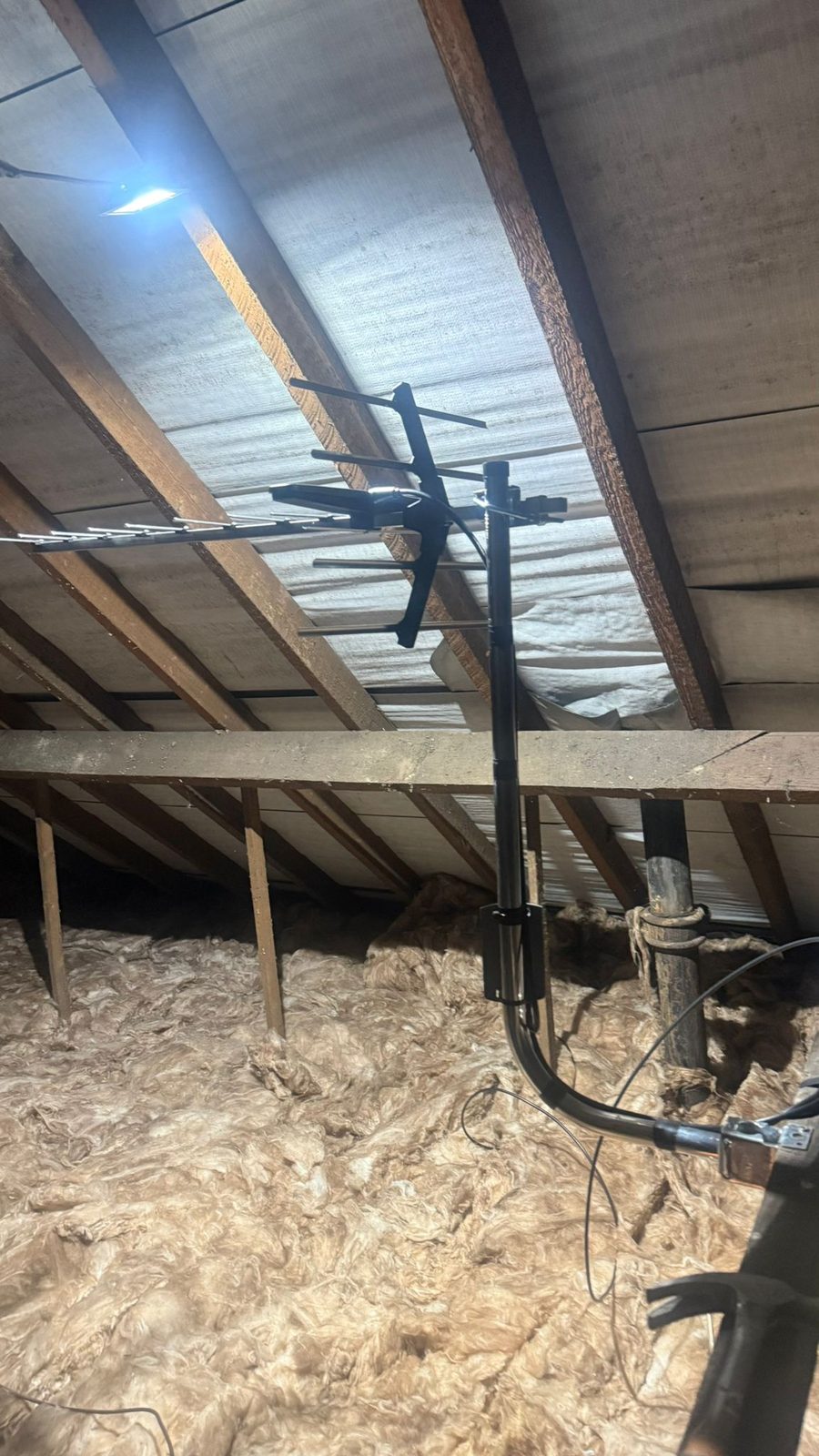
Why loft aerials are attractive
- Weather-protected. No UV, no rain, no wind loading. Aerials last longer indoors.
- No roof access needed. Cheaper to fit, no scaffolding, no chimney lashing.
- Tidier install. No visible aerial on the property.
- Landlord-friendly. Common in leasehold flats where external aerials aren't allowed.
A loft aerial can work well where the address prediction, roof construction, aerial position and measured signal provide enough usable margin. Do not infer that from a Stockport district name or a neighbouring roof. Check the full address in the current Freeview Channel Checker and confirm the actual receiving system with measurements before deciding whether a loft position is suitable.
Why some homes struggle
1. Modern roofing materials block signal
Roof coverings and insulation can attenuate or reflect UHF signals, especially where foil or other conductive layers are present, but there is no safe universal “10–15 dB” allowance for every roof. The effect depends on the complete material build-up, angle, frequency, aerial position and wanted transmitter path. Compare measured level and quality at candidate positions instead of applying one loss figure to a property type or area.
2. Distance and terrain
Terrain, buildings and the selected transmitter path can leave less usable margin at some addresses, but town names such as Marple, Romiley or Bramhall do not determine reception by themselves. Use the address-specific prediction, then compare the wanted multiplexes at the actual aerial position. If indoor placement removes too much margin, an external position may be the more reliable design.
3. Water tanks, boilers and cabling in the loft
Lofts are full of metal. A cold-water tank, boiler pipework, extractor ducting or a run of solar cabling in the wrong place will absorb and reflect signal. We've seen lofts where moving the aerial two metres transforms reception.
4. Chimney breasts and party walls
A brick chimney breast between the aerial and Winter Hill is effectively a wall of signal loss. In terraced houses, the party wall to next door can do the same. If the aerial has to sit behind either, reception suffers.
5. Freeview lite in some areas
Freeview availability varies by transmitter and address, and relay services can differ from a main transmitter. Check the current address prediction rather than assuming a universal six-multiplex service or that one particular relay is the reason channels are missing. Freeview's engineering-work information should also be checked before treating a temporary service condition as an aerial fault.
Signs your loft aerial isn't up to the job
- Persistent pixelation on the commercial or HD multiplexes (ITV, Channel 4, Film4, ITV3, BBC HD, ITV HD).
- Fine picture in summer, worse in winter (damp loft insulation absorbs more signal).
- Different rooms getting different quality despite a shared aerial.
- Random dropouts even in fine weather.
If the fault is more general pixelation across many channels, our signal pixelation guide is worth reading alongside this one.
What can be done — before giving up on a loft aerial
- Reposition it. Even 1–2 metres can transform signal if the current position is behind a chimney breast or next to a water tank.
- Fit a higher-gain aerial. A log-periodic or a high-gain Yagi can claw back the loss to the roof material, provided the signal at the loft is otherwise clean.
- Add a masthead amplifier at the aerial (not at the TV). Only if the signal is clean but weak — see our guide on whether boosters actually work.
- Renew the cable. Old low-grade coax loses more signal than modern WF100 satellite-grade cable. Sometimes the aerial is fine and the cable is the fault.
When the honest answer is an external aerial
In some houses, no amount of tweaking rescues a loft install. Foil-backed insulation, a concrete-tiled roof and a marginal signal area is a combination that a loft aerial simply can't beat. In that case the sensible next step is a proper external aerial — usually chimney-mounted, sometimes wall-mounted or on a pole where the chimney isn't suitable. Our TV aerial installation page covers what a new install includes, and this guide is a fair-minded look at when replacement beats another repair.
How we approach it
Evolution Data & Digital is a local, engineer-led aerial business — not a call centre or a franchise. We cover Stockport, South Manchester, Tameside and East Cheshire, and the same engineer surveys, quotes and fits the work. If a loft aerial can be made to work at your address, we'll tell you. If it can't, we'll say that too — and quote a fair price for the alternative, before any work begins.
Frequently asked questions
Do loft aerials work as well as external ones?
In strong-signal areas with older roofing materials, close to a main transmitter, they can be almost as good. In marginal areas or homes with foil-backed insulation and concrete tiles, they usually fall short and a chimney-mounted external aerial is the reliable answer.
Can I fit a booster to make a loft aerial work?
Only if the signal at the aerial is weak but clean. If the roof is absorbing signal unevenly, a booster amplifies the problems as well as the signal. A proper meter test tells you which situation you're in.
Will moving my loft aerial fix reception?
Often yes. Water tanks, chimney breasts, pipework and metallic ducting all create shadowed spots in a loft. Moving the aerial by a metre or two — or fitting it in a different part of the loft altogether — can genuinely transform the picture without spending on new kit.
Need help with TV signal problems in Stockport, South Manchester, Tameside or East Cheshire? Evolution Data & Digital is a local, engineer-led business — not a call centre or franchise. We test the system properly, explain the fault and agree the price before any repair or installation work begins. Call 0161 399 1757 or contact us online.
Clear written quotation before any chargeable work. Short-notice appointments may be available across Stockport, Greater Manchester and Cheshire.