
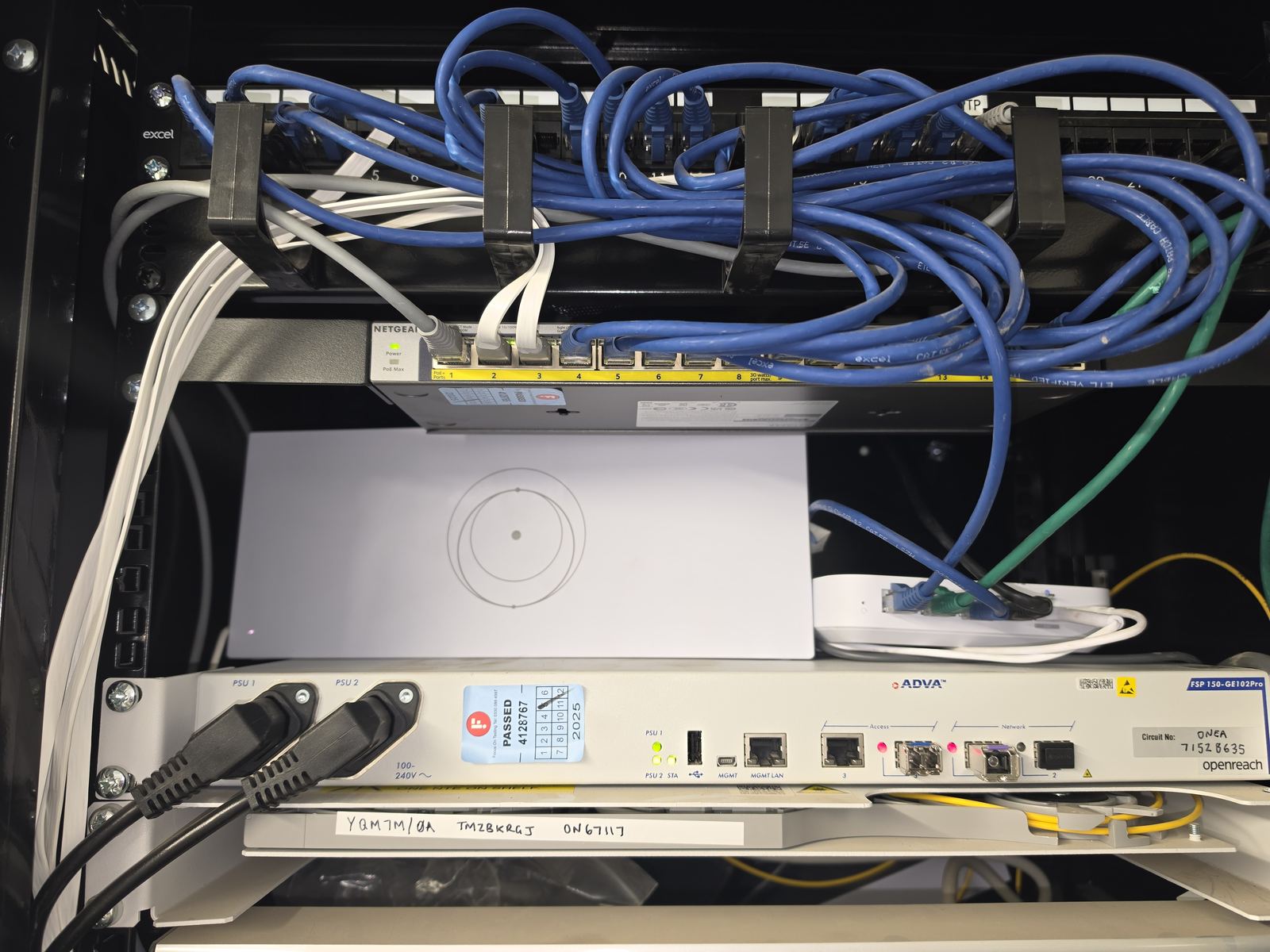
Fibre within a wider rural or multi-building installation
For incoming internet, building links, outdoor Wi-Fi and connected equipment planned as one permanent customer-owned system, see Remote Site Connectivity. The fibre specification, route and testing remain part of the cabling scope agreed for the project.
Network fibre cabling — not Openreach or ISP line repair
This service is for fibre inside or between customer-owned networks: switch-to-switch links, cabinet-to-cabinet links, floor or building backbones and fibre runs between premises on the same site. We do not repair provider-owned incoming fibre from Openreach, BT, Virgin Media or another ISP, including overhead drop cables, the public access network or faults between the provider network and your ONT.
Fibre installation for switches, racks and network backbones
Our fibre cabling work covers new fibre optic cabling, planned fibre installation, fibre networking between switches and cabinets, fibre termination or splicing, and testing matched to the project. The goal is a reliable network backbone — not simply installing fibre because it sounds more advanced than copper.
- Switch-to-switch fibre links
- Rack-to-rack and cabinet backbone links
- Floor-to-floor network fibre
- Building-to-building fibre cabling
- Fibre patch boxes and cabinet termination
- SFP / SFP+ integration with suitable switching
- Pre-terminated fibre installation
- Termination, splicing and testing where required
Building-to-building fibre and long network runs
Fibre is particularly useful where two buildings need to share a network, where a backbone run is too long or unsuitable for copper, or where electrical interference and separation between buildings make fibre the cleaner option. We plan the route, cable type, protection, termination point and switch optics around the actual site rather than forcing one standard design onto every project.
- Offices linked to workshops or warehouses
- Main building to outbuilding or remote office
- Separate floors linked back to a central comms room
- Long backbone runs between network cabinets
- Commercial sites where fibre provides electrical isolation between buildings
- Network upgrades where higher-capacity backbone links are required
Single-mode OS2 or multimode OM4?
The right fibre depends on distance, the switches and optics already in use, the route and the likely upgrade path. OS2 single-mode is often the sensible choice for new longer-distance or building-backbone links, while OM4 multimode can suit shorter links and sites that already use multimode optics. We match the fibre and SFP/SFP+ modules to the network rather than treating one type as universally better.
Fibre termination, splicing and testing
Where pre-terminated fibre is the cleanest option, we can install and protect the pre-made link. Where the project requires on-site termination or splicing, that work is available too. Appropriate fibre testing is matched to the installation and the agreed handover requirement, with the method and test equipment selected for the project. We do not make blanket claims that every job needs the same test process or specialist instrument.
- Pre-terminated fibre where it reduces risk and site time
- Termination or splicing where the project requires it
- Patch-box and cabinet handover
- Polarity and link checks appropriate to the installation
- Project-specific test records where agreed in scope
- Clear labelling at both ends of the link
Existing customer-owned fibre faults
If the failed fibre is a known private link between your own switches, racks, floors or buildings, we can assess whether replacement, retermination or splicing is the sensible route. If the fault is on the incoming broadband fibre or provider network, it needs to go back to the ISP or network operator.
Before travelling, we will normally ask for photos of both ends, the switch or media-converter model, any SFP/SFP+ modules and a description of what has stopped working. A quote or non-invasive assessment is free; if hands-on fault diagnosis or specialist testing is needed before the scope can be confirmed, we explain any charge before that diagnostic work starts.
Fibre optic cabling for Manchester commercial networks
For Manchester offices, commercial premises and multi-building sites, this page is the specialist owner for customer-owned fibre backbone work. Copper outlet and structured-cabling projects remain on our Manchester data cabling page, while larger moves and refurbishments can combine fibre, cabinets, switching, Wi-Fi, phones and AV through our Manchester office technology fit-out service. Keeping those scopes distinct means fibre is specified where the route, distance, electrical separation or backbone requirement actually justifies it.
Fibre networking for commercial sites
Network fibre is most valuable when it solves a real infrastructure problem: linking comms rooms, carrying a backbone between buildings, supporting high-capacity switch uplinks or creating a clean route where copper is not appropriate. We can install the fibre as a standalone cabling project or as part of a wider network upgrade.
- Offices and multi-floor commercial buildings
- Warehouses, workshops and light-industrial sites
- Care environments and multi-building sites
- Hospitality venues with separated network areas
- Retail and mixed-use commercial premises
- Remote offices and outbuildings on the same site
Fibre or Cat6 / Cat6A?
Fibre is not automatically the right answer. For ordinary desk outlets, access points, cameras and shorter Ethernet runs, Cat6 or Cat6A can be simpler and more economical. Fibre becomes more useful as a backbone between network equipment, for longer routes, between buildings or where the electrical characteristics of copper make it a poor fit. For copper structured cabling, see our data cabling service.
North West fibre cabling coverage
We take on suitable fibre optic network cabling projects across the North West, with the strongest day-to-day coverage around Greater Manchester and Cheshire. The regional links below give broader local service context without changing the scope of this North West fibre page.
How we scope a fibre job before travelling
Good fibre work starts with knowing what the link is meant to connect. Send the approximate route, distance, a photo of each end and, where possible, the switch or optic model. For a new installation we can then decide whether pre-terminated fibre, on-site termination or another network design is the proportionate solution. For an existing fault, those details help us separate a customer-owned network problem from an ISP/Openreach issue before anyone drives to site.
Additional service areas & regional projects
Coverage varies by distance and scope. Nearby Greater Manchester areas can suit the full service range, while farther regional work is weighted toward substantial planned projects. We confirm the postcode and scope before a visit is arranged.
- Preston
- Blackburn
- Blackpool & Fylde
- Macclesfield
- Congleton
- Chester
- Glossop
- New Mills
- Whaley Bridge
- Bolton
- Bury
- Wigan