
Quick answer
Yes, a TV can be mounted safely on a plasterboard wall. The important question is what the plasterboard is fixed to, the condition of the wall, the combined TV and bracket load, and whether the bracket sits flat to the wall or projects out on an arm. The fixing method should be chosen for that actual wall — not simply for the screen size printed on the box.
"Plasterboard wall" covers several different UK wall constructions. Two walls can sound equally hollow when you tap them and need completely different fixing approaches. That is why blanket advice such as "always find a stud" or "just use heavy-duty plasterboard fixings" can both be wrong depending on what is behind the board.
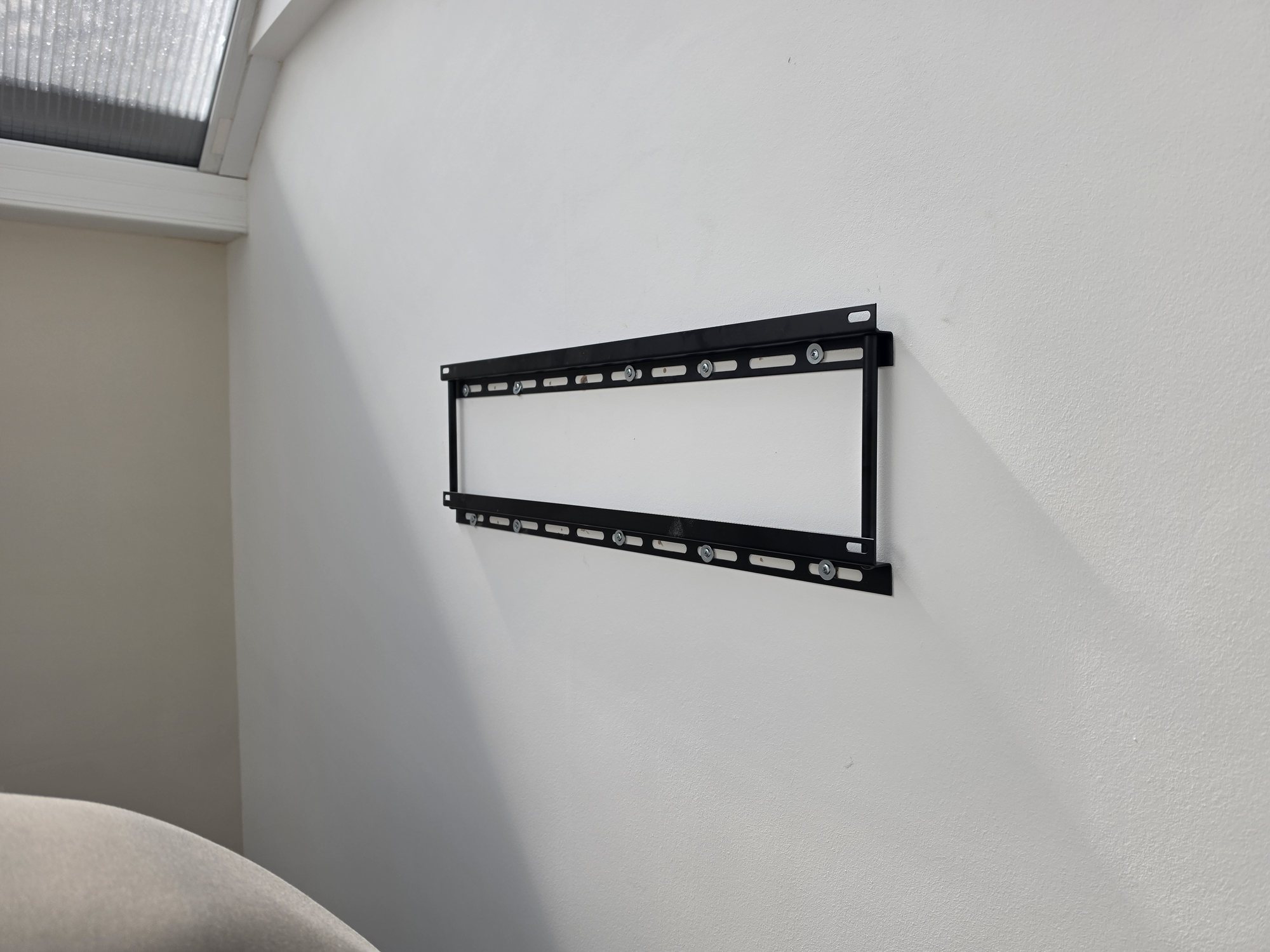
What type of plasterboard wall do you have?

Plasterboard on timber studs
Timber stud walls are common in internal partitions. Where the bracket position allows it, fixing into suitable structural timber gives a clear load path. The complication is that stud spacing rarely lands exactly where a customer wants the screen, and not every piece of timber behind a wall is suitable framing.
A detector helps locate likely framing and also helps check for hidden services, but no detector is a licence to drill blindly. The wall and bracket still need to be assessed as a complete installation.
Can you mount a TV on plasterboard without hitting a timber stud?
Sometimes. Properly rated cavity-fixing systems exist and can be appropriate on suitable board and suitable loads. What we would not do is turn that into a universal screen-size chart. The board thickness and condition, number and spacing of fixings, TV weight, bracket weight and bracket type all change the load.
If a fixing manufacturer gives a tested load rating, follow the complete instructions for the exact fixing, board thickness, cavity depth and attachment rather than carrying one number across to a different wall. For example, fischer's current DuoHM product and installation guidance lists TV mountings as an application and publishes model-specific board and load limits. Those figures apply to that documented fixing and test setup, not to every plasterboard fixing. Also check the exact TV and bracket manufacturer's weight, mounting-interface, spacer and installation instructions. If the wall construction or product instructions cannot be verified, stop and assess the installation on site rather than choosing a fixing from screen size alone.
Dot-and-dab plasterboard is a different wall
In many newer and refurbished properties, plasterboard is bonded in front of brick or block. The board can sound hollow even though there is masonry behind it. In that situation the fixing strategy will often be designed around the solid substrate behind the board while avoiding crushing or distorting the plasterboard face.
This is one reason a quick tap test is not enough to decide how a TV should be mounted. The depth of the void and the substrate need to be understood before the fixing is chosen.
TV size alone does not tell you whether the wall is safe
A 65-inch TV can weigh less than an older 55-inch model. Two 75-inch TVs can have very different weights. The bracket itself adds load, and the mounting pattern changes where that load enters the wall. Use the actual product weights and the bracket manufacturer's information rather than a rule based on screen inches.
Flat brackets and full-motion arms load the wall differently
A fixed bracket holds the television close to the wall. A full-motion bracket can move the TV much further out into the room. The further the weight sits from the wall, the more leverage the bracket applies to its fixings. That makes the wall assessment more important even when the television is the same weight.
If the plan is a large TV on a long articulating arm, we would rather understand the wall first than discover after drilling that the chosen bracket and chosen position are a poor match.
What about 55, 65, 75 and 85-inch TVs?
All of those sizes can be wall-mounted on the right plasterboard construction with a suitable bracket and fixing design. None of those sizes creates an automatic permission or refusal. Check the exact TV weight, the bracket, its extension from the wall and the construction behind the plasterboard.
Common mistakes with TVs on plasterboard
- Choosing fixings from the TV size alone. The actual load and bracket geometry matter.
- Assuming every hollow wall is timber stud. It may be metal stud, dry lining or a service void.
- Ignoring the bracket weight and projection. A full-motion arm changes the load on the wall.
- Drilling before checking for services. Pipes and cables can run exactly where a bracket wants to go.
- Crushing a dry-lined wall. A gap behind plasterboard changes how the fixing needs to transfer load.
- Buying the bracket before checking the wall. Sometimes a different bracket makes the preferred position much easier to achieve safely.
Can the cables be hidden as well?
Usually, but the route depends on the wall. Low-voltage HDMI, data and aerial cables can often use a cavity or an alternative concealed route. Mains power needs to be treated as electrical work rather than simply dropping a flexible lead into a wall. We can handle minor associated electrical work where appropriate to the technology installation, with specialist or notifiable work handled with a registered electrician or the customer's electrical contractor.
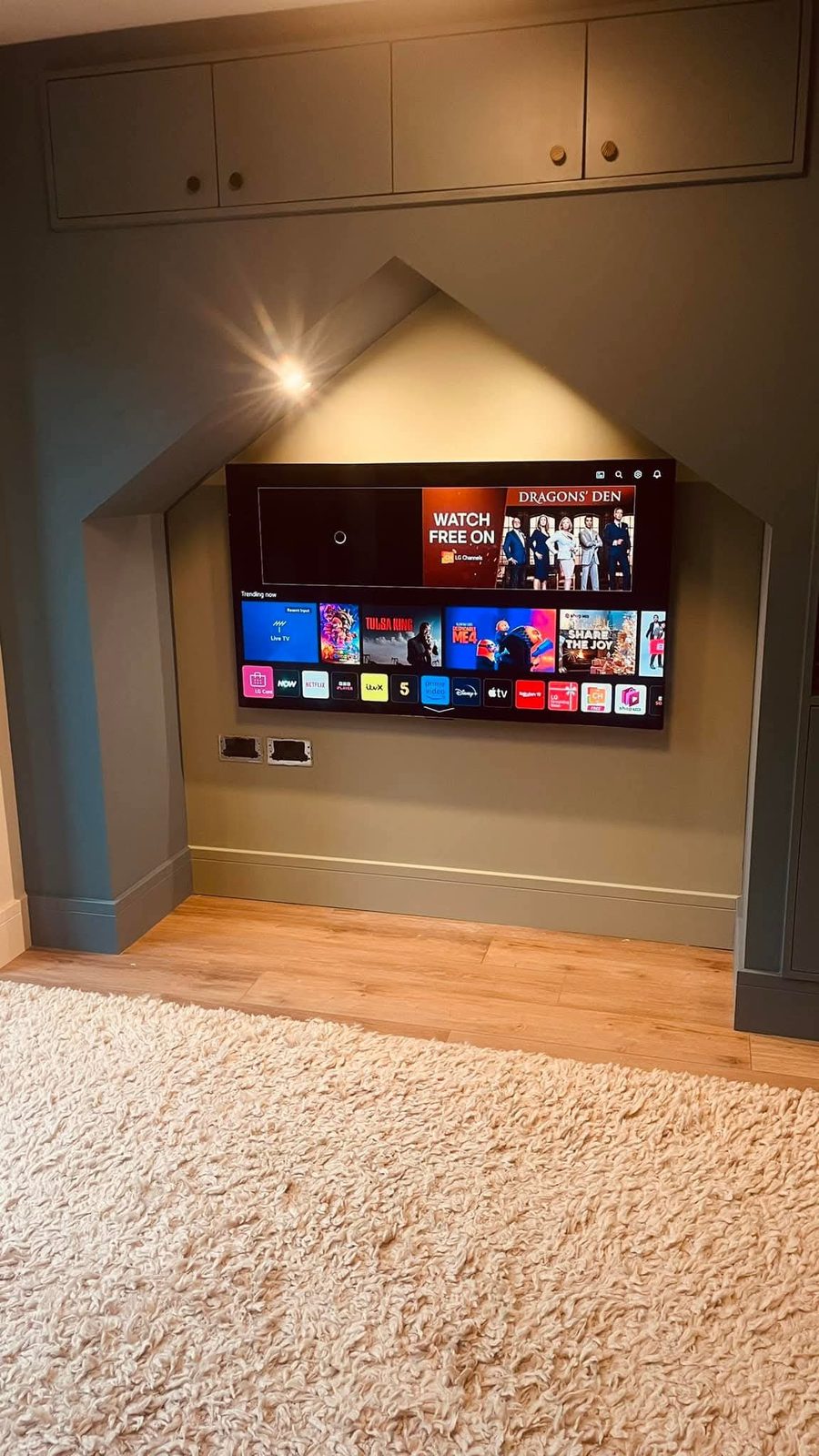
Our Manchester city-centre apartment installation is a real example: the hollow wall provided a route for low-voltage AV cables, while the bracket and fixings were chosen to distribute the television's load around that wall construction. The cable route and mounting method were planned together.
When should you get the wall checked rather than DIY it?
If the wall construction is unclear, the board is damaged, the TV is particularly large or heavy, the bracket is full-motion, services are likely behind the mounting area, or the installation needs concealed power and cabling, an on-site assessment is sensible. The aim is not to over-engineer it; it is to choose a proportionate fixing method for the wall that is actually there.
For installation examples and the service scope, see our TV wall mounting page. For the broader question of which surfaces can take a television, see can any TV be mounted on any wall?
Frequently asked questions
Can plasterboard hold a TV?
It can be part of a safe TV installation, but the answer depends on the wall construction, the board and fixing system, and the combined TV and bracket load. A blanket yes-or-no answer based only on screen size is not reliable.
Do you always have to find a stud to mount a TV?
No. Timber framing can provide useful fixing points, but suitable cavity-fixing systems and dry-lined masonry approaches also exist. The correct method depends on the wall and the load.
Can a 65-inch TV go on plasterboard?
Potentially yes. Use the actual TV weight and bracket information, not the 65-inch label, and identify what is behind the plasterboard before choosing a fixing method.
Is a full-motion TV bracket safe on plasterboard?
It can be when the wall and fixings are designed for it, but a projecting arm creates more leverage than a flat bracket. That makes the wall construction and fixing design especially important.
Can a TV be mounted on dot-and-dab plasterboard?
Yes in many cases. Dot-and-dab normally has brick or block behind the board, so the installation is assessed differently from a hollow stud partition and should avoid crushing the plasterboard face.
Clear written quotation before any chargeable work. Short-notice appointments may be available across Stockport, Greater Manchester and Cheshire.