
Quick answer
Cat6 and coax can both be useful for multi-room HDMI, but they solve the job differently. A suitable HDMI-over-Cat6 extender normally creates a dedicated point-to-point video link between a source and a remote screen. HDMI-to-DVB-T/RF modulation converts the HDMI source into a digital TV channel that can travel through a suitable coax distribution network to several compatible televisions. The better option is usually the one that matches the cabling already in the building and what each screen actually needs to do.
“Can I send HDMI over Cat6?” and “Can I use the old coax?” sound like competing questions, but there is no universal winner. A renovated house with dedicated Cat6 from an AV cupboard to every display is a very different job from a finished property where coax already reaches six TVs and no-one wants the walls opening again.
The most useful comparison is therefore not cable-category marketing. It is how each method behaves as a complete distribution system: source, transmitter/modulator, cable path, receiver or television, control method and the number of displays involved.
HDMI over Cat6: what it actually means
“HDMI over Cat6” normally means a transmitter and receiver pair using twisted-pair cabling as the transport between the source and display. The exact video format, distance, control features and cable requirements come from the extender system — not from the word Cat6 on its own.
It is also important not to assume every HDMI-over-Cat6 product is ordinary Ethernet. Many extenders use a dedicated point-to-point Cat cable link and cannot simply be plugged through a normal network switch. IP-based video distribution exists too, but that is a different architecture. We specify the route around the chosen hardware rather than treating every RJ45 socket as interchangeable.
Where Cat6 is strong
- Dedicated source-to-screen links can be planned during renovation or commercial fit-out.
- The same structured-cabling project can provide separate network and AV routes where designed that way.
- Point-to-point extenders avoid tuning the source as a television RF channel.
- Changing the endpoint equipment later can be straightforward when the cable route itself remains suitable.
Where Cat6 is not automatically the answer
- A finished property may have no practical Cat6 route to the television without disruptive work.
- One Cat6 cable does not guarantee every HDMI format or feature; the complete extender specification matters.
- Using one cable simultaneously for ordinary Ethernet and a dedicated HDMI extender is not something to assume unless the selected system is specifically designed for it.
HDMI over coax: modulation rather than native HDMI
With HDMI-to-DVB-T/RF distribution, a modulator converts the HDMI source into a digital television channel. That channel is carried through suitable coax and tuned on compatible TVs. This can be particularly effective when an existing aerial distribution network already reaches several rooms.
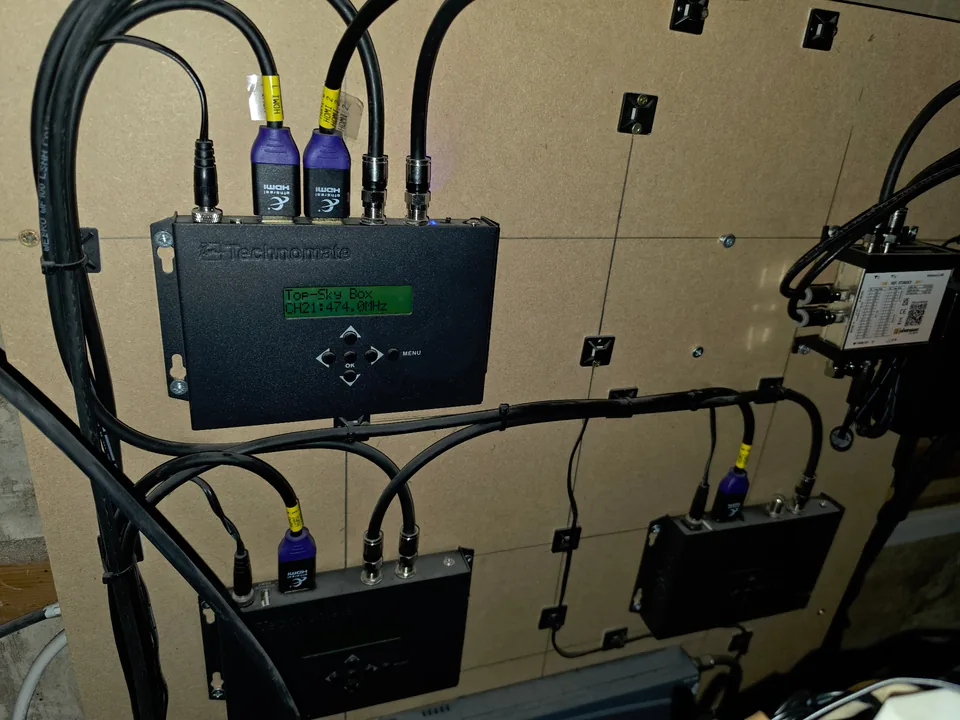
Technomate's current TM-RF HD IR V6 specification is a good example of the architecture: it accepts an HDMI source, creates DVB-T RF, can combine an aerial feed and can distribute to multiple televisions through suitable splitter/amplifier arrangements. The particular EDD installation shown below used this type of system.
Quick answer
TM-RF HD IR V6 specification checked 4 September 2026. Technomate currently lists HDMI input up to 1080p/60 with AC3 audio, DVB-T output, IR over RF, a stated delay below 0.8 seconds and distribution through a suitable amplifier or splitter. These are manufacturer specifications, not a promise that every source, television or coax network will work unchanged.
Before specification, we record and validate the exact source output, every display's DVB-T/T2 tuner and accepted format, HDCP/EDID behaviour through the full chain, required audio, acceptable latency, RF channel plan and remote-control path. Firmware, splitters, amplifiers, coax condition and the intended number of televisions are part of the same check.
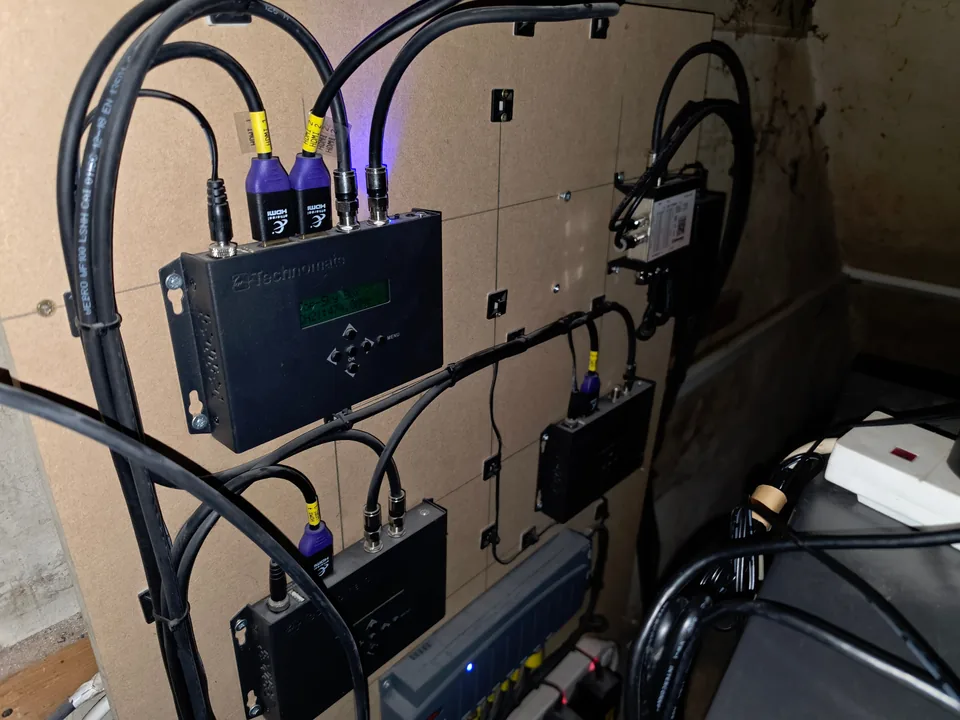
An example of EDD HDMI distribution work
The project photographs document an EDD-installed HDMI-to-DVB-T/RF modulator and the central multi-room distribution hardware, with the property's suitable coax infrastructure reused. That supports the architecture shown here: HDMI source to modulator, RF distribution hardware, coax network and compatible television tuners.
Reusing coax depends on the condition of the cabling, the RF channel plan, television compatibility and the required remote-control route. Those details are checked for your property before equipment is chosen, alongside the provider terms for the content you want to distribute.
Quick answer
Rights and terms checkpoint: technical capability is not permission to redistribute a programme or subscription service. Before specification, the customer must confirm that the intended source, account, premises type and number of screens comply with the provider's current terms and any applicable content rights. Domestic, hospitality and other commercial viewing are not treated as interchangeable.
Evidence recorded before this type of system is signed off
- Source and display inventory, required output format, audio and tuner compatibility.
- Coax routes, splitters and amplifiers assessed for condition and suitability.
- Agreed RF channel plan checked against existing aerial services.
- Remote-control method tested at each agreed viewing point.
- Picture, audio, tuning and control acceptance results recorded for each agreed route.
Where coax modulation is strong
- Existing coax may already reach every television position in a finished building.
- One modulated source can be made available to several compatible TVs through the distribution network.
- Aerial television and a modulated HDMI source can coexist in a properly designed RF system.
- Supported hardware can provide an IR return path over the coax for remote control.
Where coax modulation is not the same as HDMI over Cat6
- The TV receives a generated DVB-T/RF channel rather than a native HDMI endpoint.
- Picture format and compatibility are determined by the modulator and television tuner.
- The source is normally mirrored; several TVs receiving one modulated source do not become independent source boxes.
- The condition and design of the RF network — coax, splitters, amplifiers and channel plan — matter.
What about direct HDMI cable?
Direct HDMI should not be forgotten just because distribution products exist. For a short, accessible route between a nearby source and display, a suitable direct HDMI cable can be the simplest system of all. Problems usually arise when people try to force a long or inaccessible route to behave like a short patch lead without considering cable specification, access for replacement and connector size.
On a new installation we look at serviceability as well as whether a cable can physically be pulled through today. A route that traps an HDMI plug permanently behind finished construction can become painful if the cable or standard needs changing later.
Splitter vs switch vs matrix — the other half of the design
The transport cable is only one part of a multi-room system. The source/display relationship determines whether the central hardware should be a splitter, switch or matrix.
A matrix is useful when the requirement genuinely needs independent routing. It is not automatically an upgrade over a splitter or modulator. Adding unnecessary switching makes the system more expensive and gives future fault-finding more boxes to work through.
What matters for 4K, HDR, HDCP and EDID?
Modern HDMI is not just “picture down a cable”. The source and screen negotiate formats and copy protection, and distribution hardware sits in the middle of that conversation. If 4K, HDR, particular refresh rates or audio formats matter, the transmitter/receiver, matrix or other distribution equipment must be specified for that complete requirement.
This is why we avoid blanket claims such as “Cat6 does 4K” or “coax works with any TV”. A Cat6 cable can be part of many different extender systems, while an RF modulator may accept one input format and output another. The actual product chain decides what the screens receive.
Which would we install in a finished house?
We would start by mapping what already exists. If good coax reaches every television and the requirement is to make one or more central sources available as channels, reusing that coax can be highly proportionate. If dedicated Cat6 reaches the source and displays, a suitable extender or wider structured AV design may make more sense. If neither exists, the cable route, finishes and future plans decide what is worth installing.
Our guide to sending a Sky Q source to multiple TVs using existing coax shows a common real-world example of why the old TV cabling can still be useful.
Planning HDMI distribution in Manchester, Stockport & Cheshire
If you want the system designed and installed, our HDMI distribution installation and multi-room video service covers the source devices, screens, control requirements and existing cabling as one scope. Where Cat6 needs adding, we can coordinate that through our structured data-cabling service; where the requirement is simply extra Freeview/Freesat television points, we keep that work with our additional TV points service rather than overcomplicating it.
Frequently asked questions
Is HDMI over Cat6 better than HDMI over coax?
Not universally. Cat6 is often a strong point-to-point transport for suitable HDMI extenders; coax can be excellent when an existing TV distribution network reaches several screens and HDMI-to-DVB-T/RF modulation suits the requirement.
Can I plug an HDMI-over-Cat6 extender into my network switch?
Do not assume so. Many HDMI extenders use a dedicated point-to-point twisted-pair link rather than ordinary Ethernet. Only IP-based systems specifically designed for network switching should be connected through an Ethernet network in that way.
Can HDMI really go through aerial coax?
A suitable RF modulator converts the HDMI source into a digital DVB-T/RF television channel, which can then be carried by a suitable coax distribution network. The coax is carrying the modulated TV signal, not native HDMI signalling.
Do I need an HDMI matrix for multiple TVs?
Only if the requirement needs several sources routed independently to several displays. If every television needs the same source, a simpler splitter or RF distribution architecture may be more proportionate.
Does Cat6 guarantee 4K HDMI?
No. The cable is only one part of the system. The extender or matrix hardware, link length and installation, source/display capability, HDCP/EDID behaviour and required video format all matter.
Clear written quotation before any chargeable work. Short-notice appointments may be available across Stockport, Greater Manchester and Cheshire.