Quick answer
Yes — suitable existing coax can sometimes be reused to make the output of one Sky Q box available on several TVs. A common method is to convert the box's HDMI output into a DVB-T/RF television channel and feed that into the coax distribution system. Every connected television then sees the same Sky Q source. It does not give each room independent Sky channels; Sky's own Multiscreen / Sky Q Mini route is designed for that.
A lot of houses already have coax running from a central cupboard, loft or old amplifier to several television positions. When the original aerial or Sky distribution arrangement changes, those cables do not automatically become useless. If the coax network is in suitable condition and the televisions are compatible with the chosen modulation system, it can be a very practical way of distributing a central HDMI source without opening finished walls for another cable.
The important distinction is what the system is being asked to do. There is a big difference between mirroring one Sky Q box around the house and letting several rooms choose different Sky channels independently.
If the question is not specifically about Sky Q, use our broader guide to distributing HDMI to multiple TVs using coax, Cat6, splitters or a matrix. This page stays focused on the Sky Q-specific limits, control method and independent-viewing distinction.
Current Sky and modulator source checkpoint
Evolution Data & Digital checked Sky's current different-room guidance and the named Technomate model documentation on 4 September 2026. At that check, Sky Q Mini remained Sky's route for independent room viewing under the applicable Multiscreen arrangement; distributing one box's output still mirrors that source.
Product pages, account terminology, supported resolutions, RF standards and IR accessories can change. The exact modulator manual and current Sky account terms must therefore be checked again when a job is specified. This article does not treat the pictured model as approval for another property or as permission to redistribute subscription content.
What happens when Sky Q is distributed over existing coax?
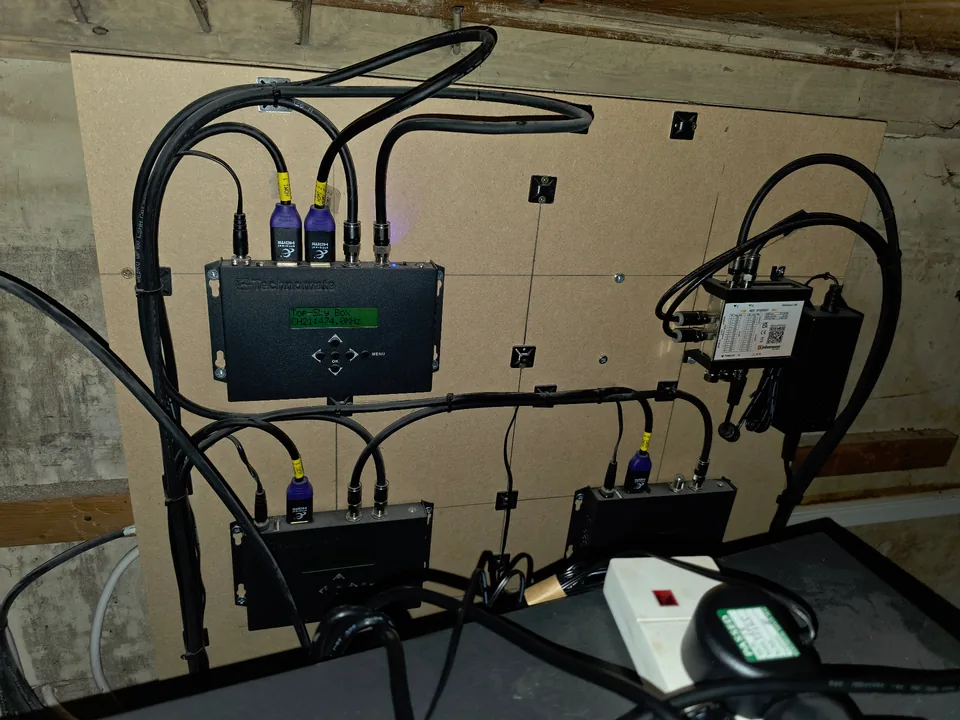
The Sky Q box still produces HDMI in the normal way. A suitable HDMI-to-DVB-T/RF modulator takes that HDMI output and creates a digital television channel. That RF channel is then combined into the building's coax distribution network and tuned on compatible televisions in the other rooms.
Technomate's TM-RF HD IR V6 documentation, checked 4 September 2026, describes this architecture: an HDMI source is converted to DVB-T RF, distributed through coax, and can be combined with an existing aerial feed. Its published specification also includes IR return over compatible coax arrangements so the source can be controlled from another room.
That does not mean the coax cable has somehow become an HDMI cable. The television receives a modulated digital TV channel created from the HDMI source. That difference matters when comparing picture formats, control methods and what equipment is needed at each end.
Can each TV watch a different Sky channel?
Not when several TVs are simply receiving the output of one Sky Q box. They are all watching the same source, so changing the channel on that box changes the programme being distributed to the other rooms as well.
If different rooms need different Sky programmes at the same time, Sky's different-room guidance, checked 4 September 2026, identifies Sky Multiscreen and Sky Q Mini boxes as the Sky Q route for independent viewing. Sky also states that older tvLINK arrangements do not work with Sky Q boxes.
Can Freeview and a distributed Sky Q source share the same coax?
They can in a correctly designed system. Some HDMI RF modulators include an RF input specifically so an aerial feed can be combined with the new modulated channel. The channel plan, amplifier/splitter arrangement, signal levels and the condition of the existing coax still need to be sensible; plugging boxes together without checking the RF system can create reception problems rather than solve them.
If the requirement is primarily extra Freeview or Freesat outlets rather than an HDMI source, see our additional TV points and signal-distribution service instead.
How do you control the Sky Q box from another room?
That depends on the distribution hardware. The Technomate system shown in our installation photographs supports infrared control over a compatible coax arrangement using its IR transmitter/receiver system. Other HDMI distribution products use different IR return, network control or manufacturer-specific methods.
Control should therefore be part of the design from the start. A picture on the bedroom TV is not much use if the only way to change the source is to walk back to the equipment cupboard every time.
When is existing coax a particularly good option?
- Finished properties: coax already reaches the television positions and opening walls would be disproportionate.
- Several TVs need the same source: a central modulated source can be distributed through the existing TV network.
- Aerial television is still required: a suitable design can combine the aerial service and the modulated HDMI source.
- Central equipment needs to stay hidden: source boxes can remain in an equipment area rather than being stacked beside every TV.
When would Cat6 be the better route?
If a dedicated Cat6 / Cat6a cable already runs from the source position to one remote display, or the property is being renovated and new structured cabling can be installed cleanly, an HDMI extender over twisted-pair cabling can be a more direct point-to-point solution. It avoids turning the HDMI source into a broadcast TV channel and can suit projects where the required video format and extender hardware are chosen together.
Our HDMI over Cat6 vs coax guide compares the two approaches in more detail. If a new cable route is needed, our data-cabling service covers the structured-cabling side as part of the project.
Common mistakes when trying to reuse old TV cabling
- Assuming every piece of coax, splitter and amplifier in an inherited system is still connected or suitable.
- Expecting several TVs fed from one Sky Q box to show different Sky channels independently.
- Buying a modulator without checking television compatibility and the required output format.
- Forgetting remote control / IR return until after the picture is working.
- Adding an RF channel without considering the existing aerial channel plan and distribution levels.
- Assuming a product labelled “4K compatible TV” means the modulated video itself is automatically distributed in 4K.
An example of EDD multi-room TV work
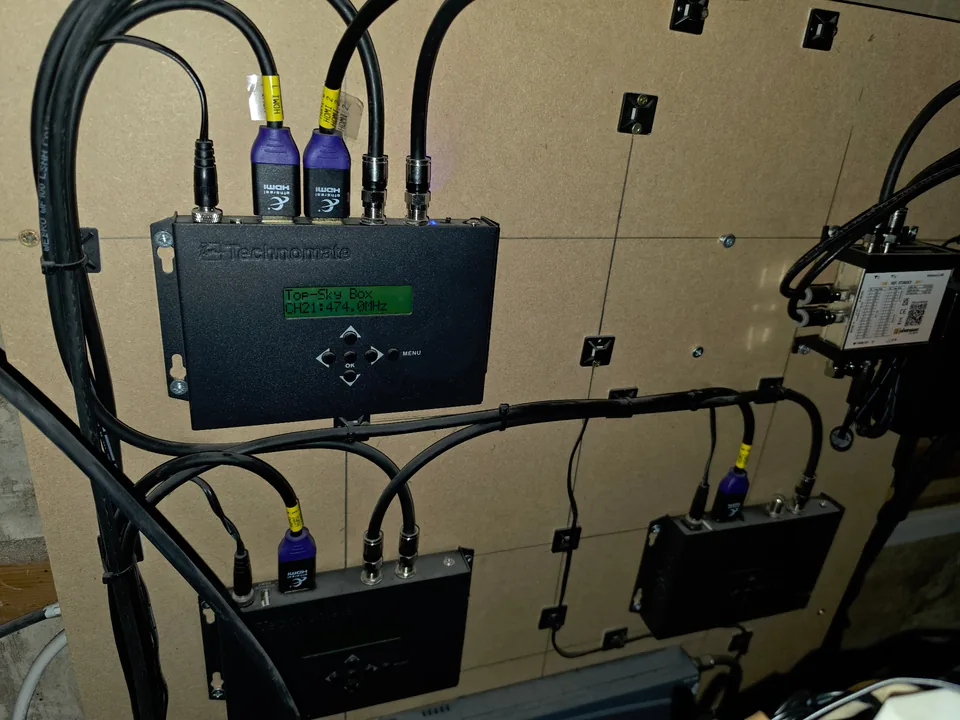
The project images document multiple HDMI sources connected to installed DVB-T/RF modulators and central RF distribution equipment. They support the architecture described on this page: source HDMI is converted into tuned channels and then carried through suitable coax to compatible televisions.
For your installation, we check the coax, channel plan, output format, television compatibility and remote-control route together. The equipment in these photographs illustrates the approach; the final setup depends on the system at your property.
Quick answer
Rights and provider-terms checkpoint: being able to distribute a Sky Q output technically does not grant permission to use or redistribute subscription content. Before work is specified, the customer must check the current Sky agreement for the account, premises and intended screens. Residential, communal, hospitality and other business viewing arrangements are not assumed to have the same rights.
Installation and acceptance record
- Assess the actual coax routes, splitters, amplifiers and signal condition.
- Record each source, required output format and compatible destination television.
- Document the RF channel plan and check it alongside existing aerial services.
- Record the selected IR/control method and test it at every agreed viewing point.
- Sign off picture, audio, tuning and control results for each agreed route.
Sky Q distribution as part of a wider HDMI system
If you want a Sky Q or other HDMI source distributed around the property, our HDMI distribution installation and multi-room video service covers the design and installation. Send the source location, destination TVs and any existing coax or Cat6 routes; we then choose whether the sensible route is suitable coax/RF modulation, Cat6, direct HDMI or a more structured switching/matrix system.
That means an existing coax network can be treated as useful infrastructure where it genuinely suits the job — not automatically ripped out because the source happens to use HDMI.
Frequently asked questions
Can I send Sky Q to a second TV without a Sky Q Mini?
A suitable HDMI distribution system can mirror the output of one Sky Q box to another compatible television. That is different from Sky Multiscreen: both TVs are sharing the same Sky Q source rather than choosing separate Sky channels independently.
Can Sky Q use the old coax cables already in my house?
The Sky Q HDMI output can sometimes be converted to a DVB-T/RF channel and distributed over suitable existing coax. The coax network, amplifiers/splitters, TVs and control requirement need checking before specifying the system.
Do old Sky magic eyes work with Sky Q?
Sky states that tvLINKs do not work with Sky Q boxes. Modern HDMI-to-RF distribution systems can provide their own supported IR-return method, but that is a separate arrangement and depends on the chosen hardware.
Can Freeview and Sky Q distribution use the same coax?
They can where the RF system and chosen modulator are designed to combine the aerial feed with the new digital RF channel. Signal levels, channel planning and the existing distribution hardware still need to be checked.
Will every room get a different Sky channel?
Not from one distributed Sky Q box. A mirrored distribution follows the output of that box. For different Sky channels at the same time, Sky's Multiscreen / Sky Q Mini system is designed for independent room viewing.
Clear written quotation before any chargeable work. Short-notice appointments may be available across Stockport, Greater Manchester and Cheshire.