
This is a risk-screening guide, not blanket permission to remove an aerial yourself and not legal or insurance advice. The safe route depends on the exact position, access, structure, weather, nearby services, weight and condition of the hardware. If the job requires climbing, leaning out, getting onto a roof or controlling a heavy or corroded assembly, stop and arrange a competent work-at-height assessment.
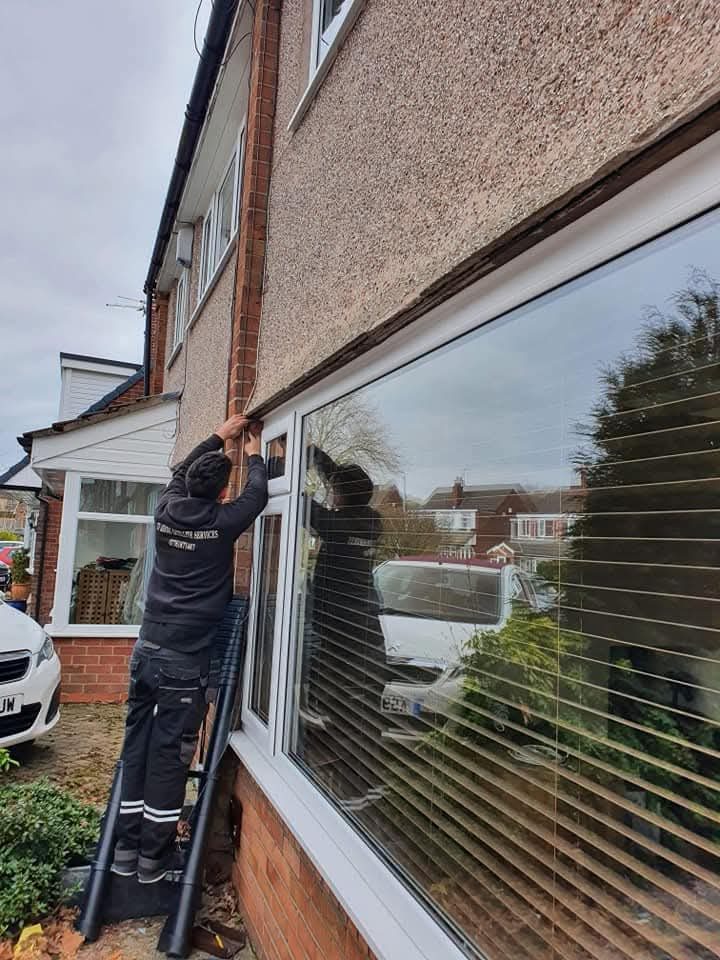
Start with the work-at-height hierarchy
The HSE's current work-at-height guidance (checked 5 September 2026) says to avoid work at height where reasonably practicable, prevent falls where it cannot be avoided, and minimise the distance and consequences of a fall. HSE also explains that ladders can be suitable only for low-risk, short-duration work with sensible precautions. A short job, familiarity with ladders or owning access equipment does not by itself establish that the work is low risk.
| Check | Only consider a lower-risk task when | Stop and arrange competent help when |
|---|---|---|
| Height and access | The item is stable at ground level and no step, ladder, roof access or leaning-out is needed. | Any climbing, ladder use, roof access, unprotected edge or awkward reach is involved. |
| Working position | Footing is level, firm, clear and gives a stable position throughout the task. | The surface is fragile, sloping, wet, obstructed or cannot support a safe working position. |
| Fixings and load | The item is already detached, light and can be controlled without force or cutting tensioned parts. | Fixings are corroded or structural, or the pole, bracket, masonry or aerial could move together. |
| Overhead and electrical hazards | There are no overhead lines, solar equipment, exposed supplies or uncertain services nearby. | Any line or service is present or uncertain. HSE says overhead lines should be treated as live unless their owner proves otherwise. |
| Weather and area below | Conditions are calm and dry, and the area below is isolated from people, vehicles and glazing. | Wind, rain, ice, poor light or an uncontrolled drop zone could affect the work. |
| Watertight finish | No fixing or cable penetration is being opened, or the correct substrate-specific repair is already known. | Removal exposes roof, render, masonry or cable entries and the weatherproof repair is uncertain. |
For overhead-line planning, read HSE's overhead power-line guidance. Do not estimate a safe clearance from this article.
Stop and use a competent professional when any of these apply
- Roof, chimney, gable or first-floor work. Any route that requires a ladder, roof access or reaching beyond a protected working position needs a task-specific plan and suitable equipment selected by a competent person.
- Fragile or uncertain surfaces. Roof sheets, tiles, loft ceilings, old masonry, gutters and weathered fixings can fail without warning.
- Electricity or other services nearby. Overhead lines, solar equipment and concealed supplies introduce hazards that cannot be judged from a generic web guide.
- Loose, corroded or heavy assemblies. The aerial, pole, bracket or masonry may move together and create both fall and falling-object risks.
- No controlled area below. People, vehicles, glazing and neighbouring property must not be exposed to dropped tools or equipment.
- Unclear weatherproofing or structural repair. Removing fixings can expose damaged brickwork, render, roof coverings or cable penetrations that need the right repair method.
Lower-level tasks still need task-specific judgement
An item already detached and stable at ground level may be a straightforward disposal task if it can be handled without climbing, cutting a tensioned assembly or disturbing electrical or building services. An accessible loft item may also be lower risk only where there is a safe access route, a boarded working position, adequate lighting and no fragile ceiling, electrical or heat hazard. If any of those conditions are missing or uncertain, do not proceed.
A wall-mounted item is not automatically suitable for DIY because it looks low. If a step, ladder, awkward reach, forceful tool use or support of the equipment is required, assess it as work at height and use a competent professional where the risk cannot be controlled.
Insurance wording is policy-dependent
There is no reliable universal statement that household insurance will or will not cover a particular DIY removal, injury, water ingress or damage claim. Cover, exclusions and disclosure requirements depend on the policy and circumstances. Ask the insurer or broker about the exact proposed task and keep their answer; this page does not interpret a policy or transfer responsibility for the work.
What a professional assessment should cover
- The mounting position, access route, weather and ground conditions
- Fragile surfaces, nearby services, structural condition and falling-object controls
- A safe way to support, remove and lower the actual assembly without prescribing it from photographs alone
- Repair of fixings, masonry, roof coverings and cable entries using materials suitable for the substrate
- Waste removal, site checks and a clear handover of any defect that needs another trade
Book a professional removal — Stockport, Manchester, Tameside
For anything above ground level or with uncertain access, condition or services, arrange an assessment before touching the installation. See our aerial and satellite removal service page, our aerial removal cost guide, or our Sky dish removal guide.
Frequently asked questions
Is it safe to remove a TV aerial yourself?
A generic yes or no is unsafe. If the task needs climbing, roof access, an awkward reach, forceful tool use, control of a heavy or corroded assembly, or work near services or fragile materials, stop and use a competent professional. Only genuinely ground-level or safely accessible tasks should be considered after a task-specific risk check.
Does a ground-floor aerial automatically make it a DIY job?
No. Height is only one factor. The reach, working position, need for a step or ladder, condition and weight of the bracket, nearby services, area below and weatherproof repair all affect the decision.
Can I remove an aerial from inside the loft?
Only consider it where access is safe, the working position is fully boarded and lit, and there is no fragile ceiling, electrical, heat or manual-handling hazard. Stop if access or footing is uncertain.
Will household insurance cover DIY aerial removal?
That is policy- and circumstance-dependent. Ask the insurer or broker about the exact task and keep their answer. This page is not insurance or legal advice.
What information helps a professional assess the job?
Safe ground-level photographs can help show the position, surrounding area and visible condition, but they do not replace the on-site access, structure, services and weather assessment needed before work at height.
Need help with TV signal problems in Stockport, South Manchester, Tameside or East Cheshire? Evolution Data & Digital is a local, engineer-led business — not a call centre or franchise. We test the system properly, explain the fault and agree the price before any repair or installation work begins. Call 0161 399 1757 or contact us online.
Clear written quotation before any chargeable work. Short-notice appointments may be available across Stockport, Greater Manchester and Cheshire.