
"Structured cabling" is one of those phrases that sounds like industry jargon until you have seen the alternative — an office where cables run straight from a switch under a desk to each device, with no patch panel, durable labels or dependable record. This is the plain-English explanation of the approach and what a maintainable small-business installation can include.
What structured cabling actually means
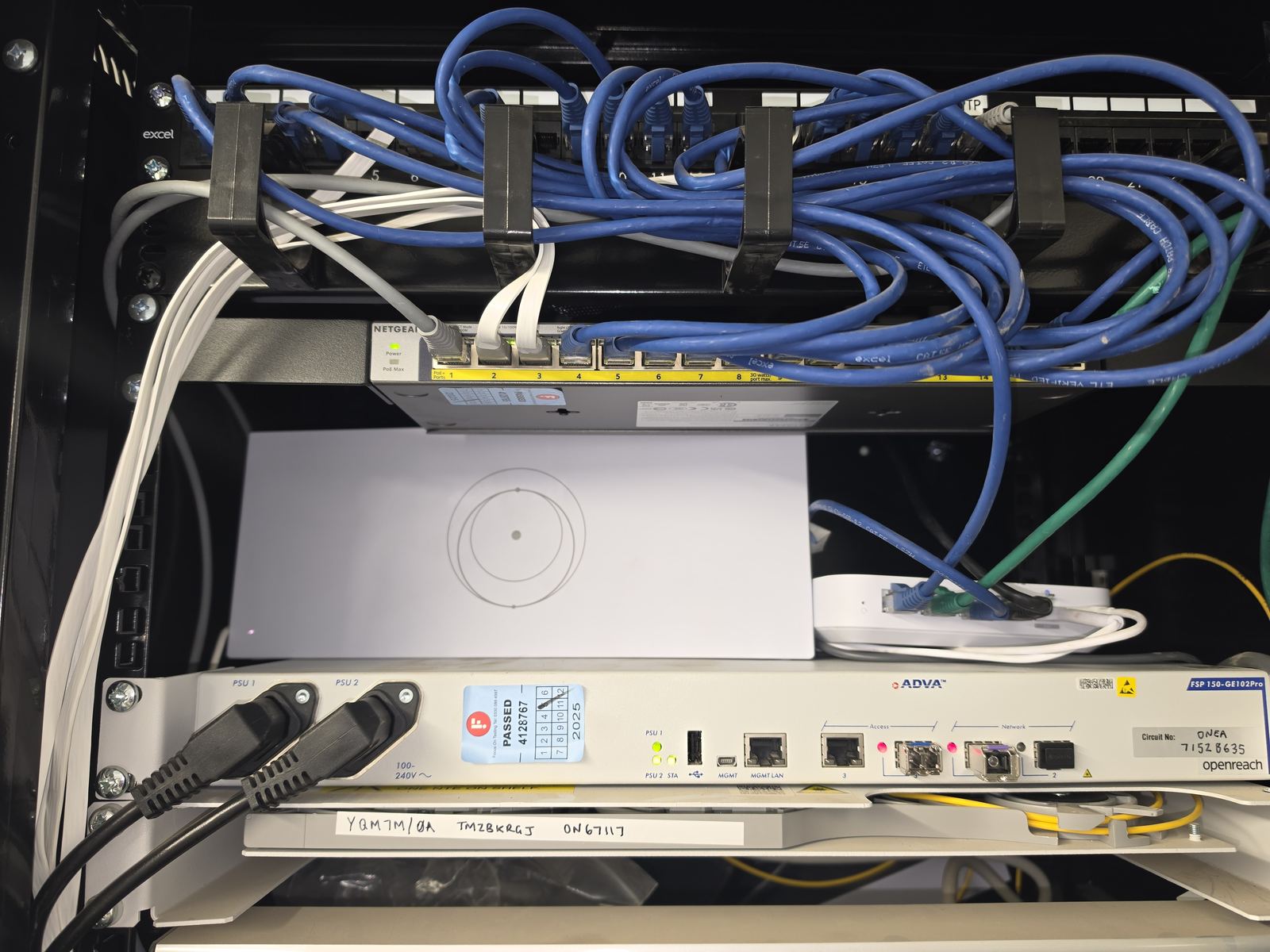
Structured cabling is a documented, standards-based approach to a building's data network. Permanent links terminate at labelled outlets and corresponding patch-panel ports. Short patch leads then connect the required services to the switch. When a desk, phone or access point changes, an engineer can identify and re-patch the documented link instead of tracing an unlabelled cable through the building.
For the equipment and configuration around those cables, see our complete small-business network setup guide.
The main parts of a structured cabling install
- Horizontal cabling — permanent runs from the work-area outlets to the cabinet, specified for the required category, route and environment.
- A telecoms cabinet — sized for the patching, switches, power, ventilation, cable management and reasonable expansion agreed in the design.
- Patch panels and outlets — consistent terminations with durable identifiers that match at both ends.
- Testing and documentation — testing matched to the agreed installation, with a patch schedule, plans and test records where these form part of the scope.
Why ad-hoc cabling becomes difficult to support
Direct, unlabelled leads can appear to solve the immediate connection, but later fault-finding, desk moves and equipment changes rely on somebody tracing the route again. Cables may be disconnected without a record, unused ports remain unidentified and a new IT provider cannot quickly see what is permanent, active or safe to change.
Structured cabling reduces that avoidable uncertainty when it is designed, installed and documented properly. Its value is operational: clearer fault isolation, controlled changes and a reusable building pathway. The financial benefit depends on the organisation's incidents, labour rates, moves, growth and maintenance approach, so it should not be presented as a fixed payback period or guaranteed saving.
If the existing cabling is usable but the patching is difficult to follow, our cabinet tidy or rebuild guide explains how to scope the work without replacing sound equipment.
What a small-business structured cabling job can include
The scope is built from the number and position of required outlets, cable pathways, fire stopping, access restrictions, working hours, cabinet and power requirements, active equipment, test standard and handover documents. Routes might use suitable ceiling spaces, containment, floor voids or partitions, subject to the building and agreed method.
Every installed link should map to the design and labelling scheme. Where switches, wireless access points, cameras or phones are included, their ports, PoE requirements and network configuration should be identified separately from the passive cabling.
Structured cabling testing: wire-map, link testing and certification
These are not interchangeable terms. A basic wire-map or continuity test checks that the conductors reach the expected pins at the far end and can expose faults such as opens, shorts, reversals or miswires. Some testers can also estimate cable length. That is useful installation evidence, but a successful wire-map result is not by itself Cat6 or Cat6A certification.
Link or performance testing can go further, depending on the instrument and agreed scope, by checking whether the installed link performs as required for the network service being handed over. Formal certification is a separate agreed test level: suitable certification equipment is used to test the permanent link or channel against the specified cabling category and test limits, with recorded pass/fail results for the handover.
The testing requirement should be agreed before installation, especially on commercial work where an IT provider, consultant or main contractor expects formal records. EDD matches the test method and documentation to the project rather than describing every cable-tester result as a certificate. For installation, upgrades and project-specific testing, see our structured cabling and data-cabling service.
What useful documentation looks like
Where documentation is part of the agreed scope, the handover can include:
- A floor plan showing installed outlets and their identifiers
- A patch schedule mapping each panel port to its destination
- Wire-map or link-performance test records at the agreed test level
- Cabinet and pathway photographs where useful for future support
- A concise record of installed switches, uplinks, VLANs and wireless networks where configured
That record helps the business or its IT provider assess a fault or change without first rediscovering the installation. It should state what was tested, what was not tested and any agreed exclusions.
Sectors we cover across Manchester and Stockport
- Dental and GP practices — connections for clinical and administrative systems, with segregation implemented to the agreed network design.
- Offices and professional services — labelled desk, phone, printer and wireless-access-point links with a cabinet and handover record.
- Care homes — resident, staff and operational connectivity alongside third-party systems where specified. See our care home case study.
- Retail and hospitality — connections for EPOS, payment, back-office and guest services, separated where the agreed network design requires it.
- Warehouses and light industrial sites — suitable containment, PoE devices and building-to-building links specified for the environment.
Cost and business case
Once the survey and scope are agreed, the quotation should identify the outlets, pathways, containment, cabinet, passive components, active equipment, access arrangements, testing, documentation, making good and exclusions. Comparing quotations on the same written scope is more useful than comparing a headline cost per outlet.
If a business needs an ROI calculation, use its own evidence: current fault and support time, planned moves, disruption cost, equipment changes and the useful scope of the proposed installation. Those inputs vary, so EDD does not promise a one-year payback, a fixed service life or a guaranteed saving.
How to specify a structured cabling job
You do not need to arrive with a completed technical design. Start with the rooms, work positions and systems that need connectivity; any PoE cameras, phones or wireless access points; relevant building constraints; operating hours; testing requirement; and handover information required by your IT provider. The survey turns that into a defined scope and schedule.
Full detail on the cabling materials and service is on the data cabling page. For switching and Wi-Fi, see the commercial network installation page. If you are weighing wired links against Wi-Fi, read our when Cat6 beats Wi-Fi guide. For the cable category decision, see our Cat6 versus Cat6a guide.
Frequently asked questions
Is structured cabling overkill for a small office?
It depends on the number of connections, expected changes and support needs. A modest labelled patch panel and documented permanent links can be proportionate for a small office, but the survey should avoid unused scope that has no clear purpose.
How long does a structured cabling install take?
The programme depends on outlet count, routes, access, working hours, fire stopping, testing, making good and whether the premises stay live. The quotation should give a site-specific schedule and state the assumptions behind it.
Do you install the network switches too?
Yes, where active equipment is included in the agreed scope. The quotation should distinguish passive cabling from switches, PoE, patch leads, firewall or router work, configuration and commissioning.
Can you cable a live office without disruption?
Some work can be phased or scheduled around operating hours, but disruption and access depend on the routes and live systems. The survey identifies isolation, access and sequencing requirements so they can be agreed before work starts.
Do you leave documentation for our IT provider?
Yes, where it is included in the agreed scope. The handover can include a floor plan, patch schedule, written test records, cabinet photographs and a network description so the provider can see what was installed and tested.
Do you cover Manchester as well as Stockport?
Yes — structured cabling work is available across Manchester, Stockport and surrounding areas, subject to the project scope and site survey.
Need Wi-Fi, cabling or a proper home network sorted across Stockport, South Manchester, Tameside or East Cheshire? Evolution Data & Digital is a local, engineer-led business — the same engineer surveys, quotes and installs. We test the property properly, explain the honest fix and agree a fixed price before any work begins. Call 0161 399 1757, send a WhatsApp, or contact us online.
Clear written quotation before any chargeable work. Short-notice appointments may be available across Stockport, Greater Manchester and Cheshire.