
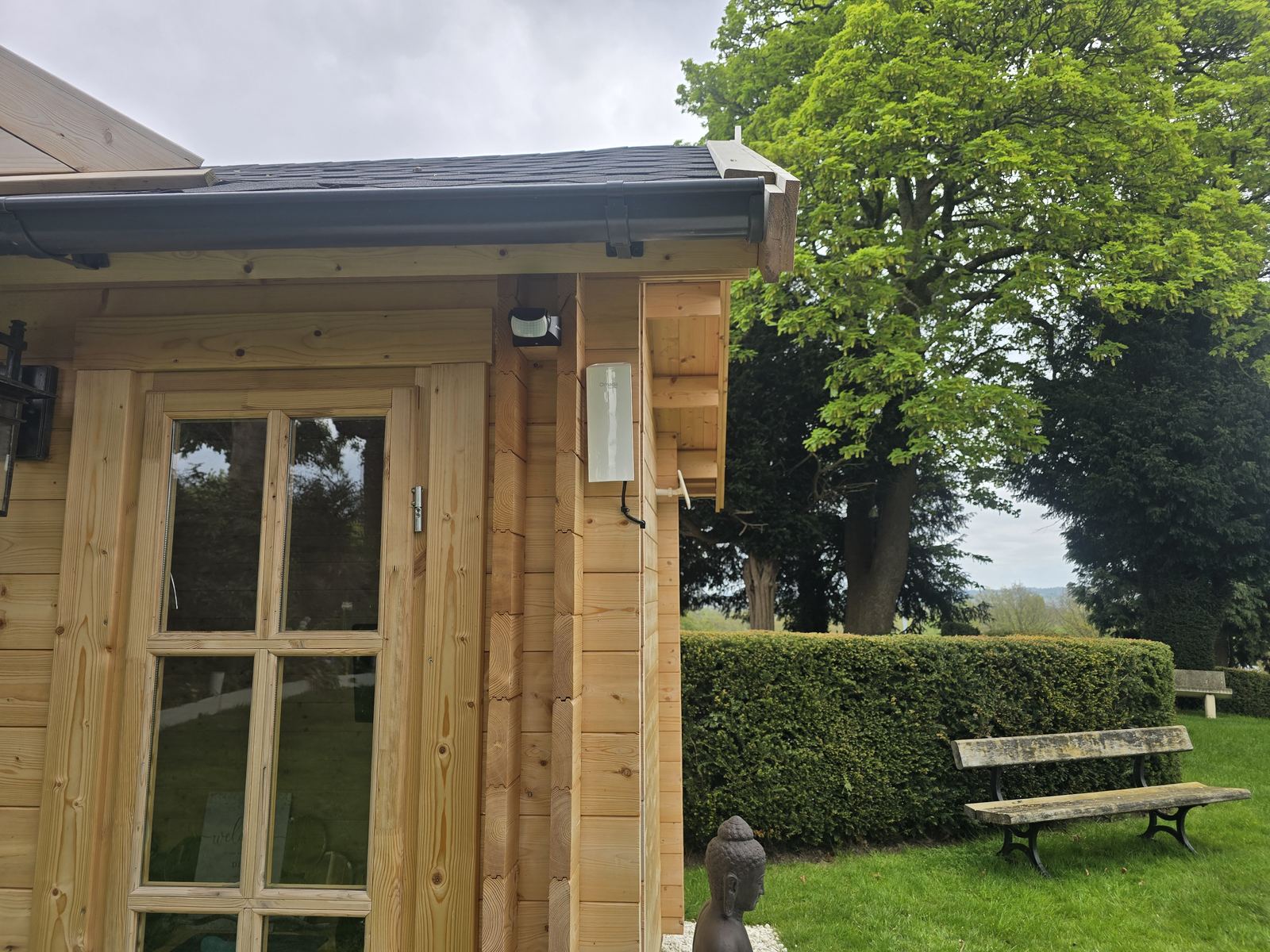
Part of a larger remote-site network
Where the link is one part of a property with several buildings, Remote Site Connectivity combines the incoming internet, permanent building links, Wi-Fi and connected equipment. This page covers the wireless-link decision and its site requirements.
Guides and real project proof
Comparing the practical options first? Read our guide to connecting two buildings by Ethernet, fibre or wireless and our garden-office and outbuilding internet guide. For a genuine completed EDD example, see the Crewe Starlink and approximately 80m wireless-bridge case study.
Connect two buildings without forcing the wrong solution
A point-to-point wireless link creates a network bridge between two separate locations using a matched radio at each end. It is useful where the buildings can see each other but trenching, ducting or an external cable route would be disruptive, expensive or impractical. The remote building can then use its own wired switch, access point or other network equipment instead of trying to catch a weak signal from the main building.
Where point-to-point wireless makes sense
The strongest use case is not simply 'more WiFi'. It is carrying a reliable network connection across a gap between buildings or site areas where a normal Ethernet run is not the sensible route.
- Office to warehouse or workshop
- Main building to barn, farm office or outbuilding
- Two commercial units on the same site
- Garden office or studio where digging is not practical
- Remote CCTV, gate or security locations
- Hospitality, holiday-park and multi-building sites
How a wireless bridge works
A radio is mounted at each end of the link and aligned across a suitable path. One side connects to the main network; the other hands that connection into the remote building. From there, the network can feed a switch, wired devices, cameras or a dedicated WiFi access point. The bridge is the backhaul between locations — it is not a substitute for properly designed WiFi inside the remote building.
Survey first: line of sight, obstructions and the actual route
Wireless links work best when the path between the two radios is genuinely suitable. Buildings, trees, terrain, moving vehicles, mounting height, local interference and the distance all affect the design. We assess the route before specifying equipment rather than quoting a radio model from a postcode and hoping it works once mounted.
- Visual path and likely obstruction changes
- Suitable mounting points at both ends
- Distance and required network capacity
- Power and network access at each building
- Interference and channel-planning considerations
- Cable route from each radio into the local network
Point-to-point wireless or fibre between buildings?
Wireless is not automatically better because it avoids digging. Where a protected route already exists — or where the site needs the capacity, predictability or electrical separation of fibre — a physical backbone may be the better long-term answer. We can compare the options instead of selling every multi-building job as a wireless one.
See our fibre optic network cabling service for customer-owned building links, or data cabling where copper Ethernet is appropriate.
Building-to-building WiFi without stretching the indoor network
The phrase "building-to-building WiFi" often describes two different jobs. The first is the wireless bridge carrying the network between buildings. The second is providing useful WiFi coverage once that connection arrives. We treat those as separate layers so the remote workshop, office or barn gets a proper local access point instead of relying on one outdoor radio to do both jobs badly.
For ordinary external coverage around one property, see outdoor WiFi installation. For a single garden room or home office, our garden office WiFi page covers the wider set of wired, mesh and wireless options.
More than two buildings
Some sites need connectivity to several separate buildings rather than one simple A-to-B link. Depending on the layout, that may mean individual point-to-point links, a point-to-multipoint design, fibre to part of the site or a mixture of technologies. We plan the topology around the buildings and traffic rather than assuming one radio arrangement fits every site.
Commercial networks, CCTV and remote equipment
A wireless bridge can form one part of a wider commercial network — for example linking a remote warehouse back to the main router, carrying CCTV traffic from another building or feeding an access point in a workshop. Where the project includes switching, VLANs, business WiFi or wider network changes, see our commercial network installation service.
Existing wireless bridge faults and upgrades
If an existing building-to-building link has become unreliable, we can inspect the mounting, alignment, cabling, power and network configuration and separate a radio-link problem from an issue elsewhere in the network. Where the existing design is fundamentally unsuitable, we will explain whether reworking the wireless link, replacing it or moving to fibre is the more sensible route.
What affects performance
We do not promise a fixed speed or distance from a generic specification sheet. Real link performance depends on the equipment, path, distance, interference, mounting, channel width, local radio conditions and the network connected at each end. We size the link around what the site actually needs and test the completed connection as part of commissioning.
North West coverage
We are Stockport-based and take on suitable point-to-point wireless and multi-building network projects across Greater Manchester, Cheshire and the wider North West. These jobs often make sense over a wider area than routine domestic call-outs because they are planned infrastructure projects rather than a simple router visit.
What affects the cost of a point-to-point wireless install
A quote or non-invasive site assessment is free. Cost depends on the number of buildings, distance and path between them, mounting access, equipment, cable routes at each end, any switching or access points required and whether the link forms part of a larger network. We agree the scope before installation rather than publishing a one-size-fits-all package price.
Additional service areas & regional projects
Coverage varies by distance and scope. Nearby Greater Manchester areas can suit the full service range, while farther regional work is weighted toward substantial planned projects. We confirm the postcode and scope before a visit is arranged.
- Preston
- Blackburn
- Blackpool & Fylde
- Macclesfield
- Congleton
- Chester
- Glossop
- New Mills
- Whaley Bridge
- Bolton
- Bury
- Wigan